



Histamine Receptor
Histamine Receptors are a class of G protein-coupled receptors with histamine as their endogenous ligand. There are four known histamine receptors: H1 receptor, H2 receptor, H3 receptor, H4 receptor. The H1 receptor is a histamine receptor belonging to the family of Rhodopsin-like G-protein-coupled receptors. This receptor, which is activated by the biogenic amine histamine, is expressed throughout the body, to be specific, in smooth muscles, on vascular endothelial cells, in the heart, and in the central nervous system. H2 receptors are positively coupled to adenylate cyclase via Gs. It is a potent stimulant of cAMP production, which leads to activation of Protein Kinase A. Histamine H3 receptors are expressed in the central nervous system and to a lesser extent the peripheral nervous system, where they act asautoreceptors in presynaptic histaminergic neurons, and also control histamine turnover by feedback inhibition of histamine synthesis and release. The Histamine H4 receptor has been shown to be involved in mediating eosinophil shape change and mast cell chemotaxis.
Histamine Receptor Isoform Specific Products
All Product Categories
-
Histamine Receptor Inhibitors
(197)
View all products
-
Histamine Receptor Agonists
(66)
View all products
-
Histamine Receptor Antagonists
(495)
View all products
-
Histamine Receptor Activators
(5)
View all products
-
Histamine Receptor Modulators
(20)
View all products
-
Histamine Receptor Controls
(9)
View all products
-
Histamine Receptor Ligands
(2)
View all products
-
Histamine Receptor Related Products (860)
Related Products (860)

-
Antibodies (2)
-
Histamine Receptor Isoform Comparison

-
(R)-Azelastine hydrochloride
 0 ImagesCat. No.: HY-B0462CCAS No.: 153408-28-7(R)-Azelastine hydrochloride, an antihistamine, has been demonstrated to down-regulate the levels of H1R, M1R, and M3R, while also inhibiting the proliferation of HNEpC.


-
Contilisant
 0 ImagesCat. No.: HY-123928CAS No.: 2135615-68-6Contilisant is a permeable antioxidant and neuroprotectant agent. Contilisant exhibits high nM affinity at H3R. Contilisant inhibits monoamine oxidases and cholinesterases. Contilisant has a binding affinity of 65.23 nM towards hS1R. Contilisant can significantly restore cognitive deficit induced by Aβ1-42 in the radial maze assay of Alzheimer’s animal model.
-
GS 283
 0 ImagesCat. No.: HY-114743CAS No.: 149440-36-8GS 283 is a compound with calcium antagonist and weak histamine and muscarinic receptor blocking activity, with activity in modulating contraction of guinea pig and rat tracheal smooth muscle. GS 283 inhibits contractions induced by carbachol, histamine (guinea pig only), and high H+ in guinea pig and rat tracheal smooth muscle, inhibits Ca2+-induced contractions in guinea pig tracheal smooth muscle, and at high concentrations completely abolishes contractions induced by carbachol in Ca2+-free medium.
-
Mepyramine hydrochloride
 0 ImagesCat. No.: HY-118807ACAS No.: 6036-95-9Synonyms: Pyrilamine hydrochlorideMepyramine hydrochloride (Pyrilamine hydrochloride) is a selective histamine H1 receptor antagonist and KCNQ channel inhibitor, with an IC50 of 12.5 μM against KCNQ2/Q3. Mepyramine hydrochloride shows no activity against allergic asthma in mice when used alone, but modulates the effect of JNJ 7777120 (HY-13508) on allergic asthma in mice; it inhibits the development of morphine physical dependence and increases histamine levels in mouse brains. Mepyramine hydrochloride can be used in studies related to seizures, convulsions, allergic asthma and morphine physical dependence.


-
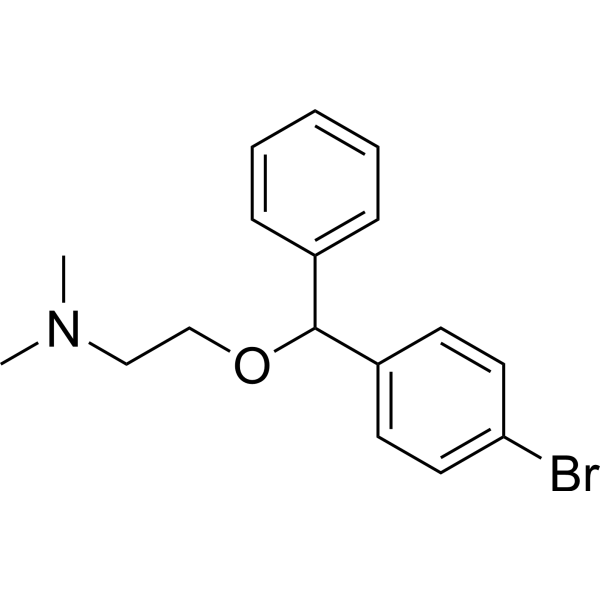
Alloclamide
 0 ImagesAlloclamide is a competitive antihistamine compound targeting the H1 histamine receptor. Alloclamide‘s core regulatory mechanism involves competitive binding to the H1 histamine receptor, blocking the activation of the receptor by histamine molecules and inhibiting various allergy-related biological responses mediated by histamine. Alloclamide can be used in allergy-related research.
-
Rupatadine-d4 fumarate
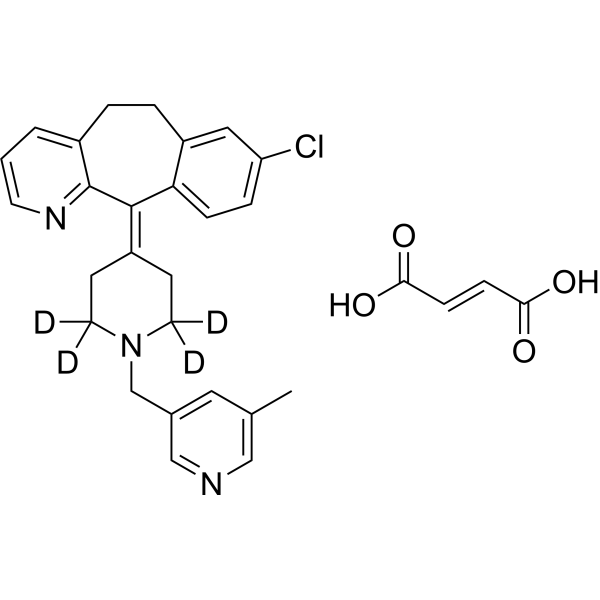 0 ImagesCat. No.: HY-13511ASCAS No.: 1795153-63-7Synonyms: UR-12592 D4 fumarateRupatadine-d4 fumarate is a deuterium labeled Rupatadine fumarate. Rupatadine Fumarate (UR-12592 Fumarate) is a potent dual PAF/H1 antagonist with Ki values of 0.55/0.1 μM (rabbit platelet membranes/guinea pig cerebellum membranes).
-
Oxmetidine
 0 ImagesCat. No.: HY-106078CAS No.: 72830-39-8Synonyms: SKF 92994Oxmetidine (SKF 92994) is an orally active H2-receptor antagonist, and is an anti-ulcer agent.
-
4-AcO-DALT hydrochloride
 0 ImagesCat. No.: HY-172339Synonyms: 4-Acetoxy DALT hydrochloride4-AcO-DALT hydrochloride is a tryptamine compound with psychoactive effects. 4-AcO-DALT hydrochloride inhibits 5-HT receptors, alpha receptors, dopamine receptors, histamine receptor 1 (H1), muscarinic M2 receptor and Sigma 2 receptor. 4-AcO-DALT hydrochloride shows Ki values of 582 nM, 2689 nM, 2099 nM, 2116 nM, 958 nM, 137 nM, 824 nM, 479 nM, 406 nM, 874 nM, 4190 nM, 482 nM, 214 nM, 803 nM, 4522 nM, 1907 nM for 5-HT1B, 5-HT1D, 5-HT1E, 5-HT2A, 5-HT2B, 5-HT2C, 5-HT6, 5-HT7A, H1, Sigma 2, α2A, α2B, α2C, D2, D3 receptors.
-
Alimemazine-d6 hydrochloride
 0 ImagesCat. No.: HY-12752BSCAS No.: 1352792-16-5Synonyms: Trimeprazine-d6 hydrochlorideAlimemazine-d6 hydrochloride (Trimeprazine-d6 hydrochloride) is the deuterium labeled Alimemazine (HY-12752). Alimemazine is a phenothiazine derivative that is generally used as an antipruritic agent and also a hemagglutinin (HA)-receptor antagonist.Alimemazine (Trimeprazine) is also acts as a partial agonist against the histamine H1 receptor (H1R) and other GPCRs. Alimemazine displays antiserotonin, antispasmodic, and antiemetic properties.
-
RS-51324
 0 ImagesCat. No.: HY-123398CAS No.: 69811-30-9
-
Quinotolast
 0 ImagesCat. No.: HY-163061CAS No.: 101193-40-2Quinotolast is an orally active antiallergic agent. Quinotolast inhibits histamine release from rat peritoneal cells. Quinotolast inhibits cutaneous cromoglycate in guinea pig model. Quinotolast has inhibitory effect on histamine and peptide leukotrienes release from guinea pig lung fragments and mouse cultured mast cells. Quinotolast can be studied in allergy-related research.
-
Dexchlorpheniramine
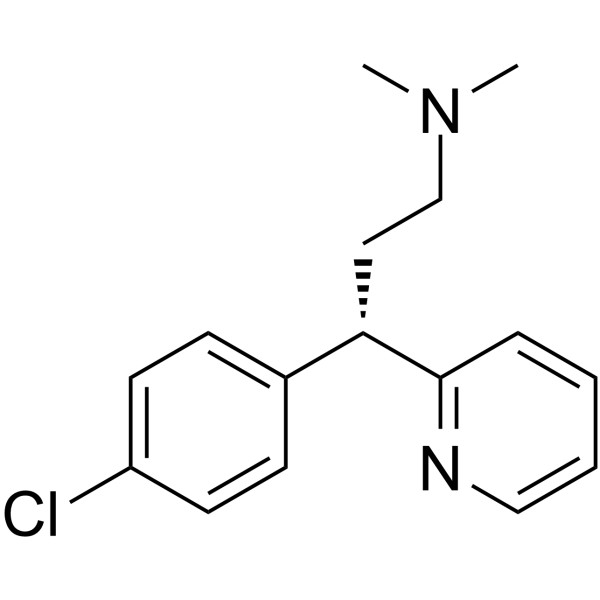 0 ImagesCat. No.: HY-117501CAS No.: 25523-97-1Dexchlorpheniramine is an potent and blood-brain barrier (BBB) penetrant histamine 1 (H1) receptor antagonist with anticholinergic properties. Dexchlorpheniramine can be used for researching allergies.
-
SUN-1334H free base
 0 ImagesCat. No.: HY-164010CAS No.: 607737-00-8SUN-1334H free base is an orally active inhibitor for histamine H1 receptor, with an IC50 of 20.3 nM and Ki of 9.7 nM. SUN-1334H free base inhibits histamine-induced contractions of isolated guinea-pig ileum with an IC50 of 0.198 μM. SUN-1334H free base inhibits histamine-induced bronchoconstriction in guinea pigs, histamine-induced skin wheals in beagle dogs, and ovalbumin-induced rhinitis in guinea pigs.
-
ST-1006 Maleate
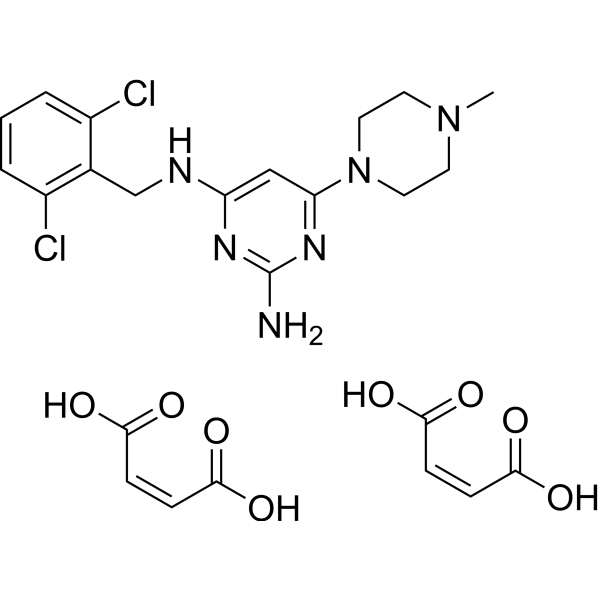 0 ImagesCat. No.: HY-120541ACAS No.: 1196994-12-3ST-1006 maleate is a potent histamine H4 receptor agonist with a pKi value of 7.94. ST-1006 maleate has anti-inflammatory effect.




